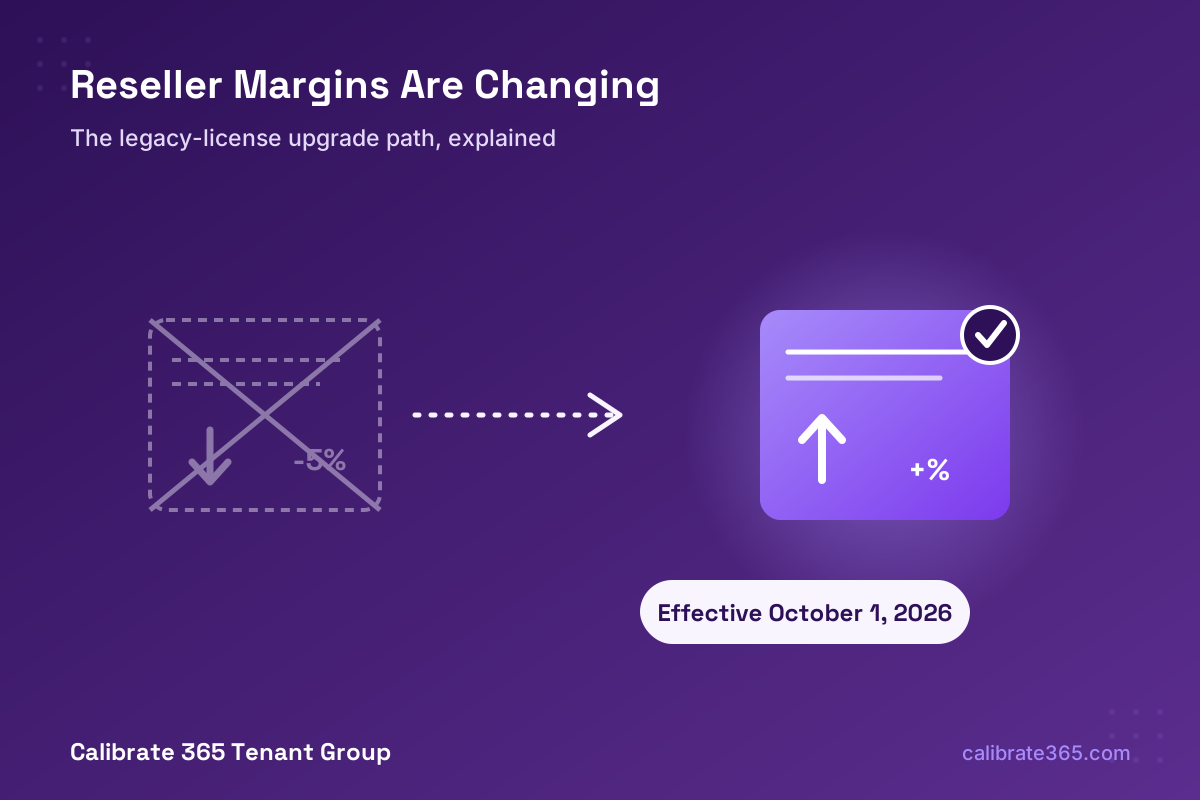
Starting October 1, 2026, Microsoft is cutting indirect reseller margins by 5% on a set of legacy and standalone NCE products, while rolling out a new Growth Margins program that pays more for net-new seats and upsells — meaning MSPs still quoting customers on old, lower-tier licenses are about to get paid less for doing the same work.
If you’re an indirect CSP reseller and a meaningful slice of your book is still sitting on legacy SKUs like Microsoft 365 Apps for Business or older, lower-tier Office and Business plans, this is the change that shows up as a smaller check at the exact same renewal volume. Here’s what’s actually happening and the upgrade path that keeps your margin where it belongs.
What’s Actually Changing
Microsoft is rebalancing how indirect resellers get paid under the New Commerce Experience (NCE): margin is moving away from flat, volume-based earning and toward a model where growth gets rewarded and standing still costs you. Two things are happening at once, both effective October 1, 2026:
- A 5% margin reduction on a set of lower-tier and standalone NCE products — the legacy SKUs a lot of long-tenured customers are still sitting on.
- A new Growth Margins program that pays additional margin, applied at the transaction level, for net-new-to-offer sales, seat expansion, and adoption of selected AI workloads — alongside new earning ceilings (19.5% for Modern Work/Dynamics 365, 15% for Azure, for qualifying partners).
The flat run-rate rebate that used to apply broadly across Modern Work and Dynamics 365 is being retired in favor of this growth-weighted structure. In plain terms: renewing a customer on the same legacy plan they’ve had for years now earns you less than it used to, while moving that customer onto a current, higher-tier plan earns you more.
The Rollout Timeline
| Date | What Happens |
|---|---|
| July 7, 2026 | Microsoft opens sandbox testing for the new margin structure. |
| July 21, 2026 | Microsoft publishes the Growth Margin Guide with full program details. |
| October 1, 2026 | The 5% margin cut on legacy/standalone products and the new Growth Margins program both take effect. |
Which Licenses Are Losing Margin
The products taking the hit are the legacy, lower-tier, and standalone plans — the SKUs that tend to be the oldest and least-touched lines on a customer’s invoice. In practice, that means:
- Microsoft 365 Apps for Business (and similar standalone Apps-only SKUs)
- Older, lower-tier Office and Microsoft 365 Business plans that customers have simply been auto-renewing year after year without anyone revisiting the fit
These are exactly the licenses that accumulate in any reseller’s book over time — nobody actively chose to keep a customer on them, they just never got upgraded.
The New Upgrade Path
The fix isn’t complicated, but it does require actually going back through your customer base:
- Legacy Microsoft 365 Apps for Business → Microsoft 365 Business Basic. This is a natural lateral move — Business Basic brings cloud email, Teams, and the full suite of web/mobile apps, on a current SKU that qualifies for current margin treatment, for roughly the same cost profile as what the customer’s used to paying.
- Lower-tier Office and Business plans → net-new Microsoft 365 Business Premium. This one matters for a specific reason: moving a customer onto Business Premium as a net-new subscription — not a simple swap, but written up as a new sale — is what qualifies for Growth Margins treatment under the new program. Business Premium also carries real customer-facing value to justify the move: advanced security, device management, and (per Microsoft’s own July 2026 packaging update) Copilot Chat built into Word, Excel, PowerPoint, Outlook, and OneNote at no extra charge.
The distinction between a routine upgrade and a net-new sale is the part worth getting right with your distributor or Partner Center setup — it’s specifically net-new seats, seat expansion, and new-to-offer sales that the Growth Margins program is built to reward, not like-for-like renewals dressed up as upgrades.
Why This Matters Beyond the Margin Math
This isn’t just about protecting a percentage point on an invoice. A customer still on Microsoft 365 Apps for Business or an old Business Basic/Standard variant is also missing security and productivity capability Microsoft has shipped in the years since — this margin change is a built-in reason to have a conversation about that gap that you might not have otherwise had a clean excuse to start.
Risks and Things to Watch For
- Don’t wait for renewal cycles to catch this. A legacy SKU renewing on autopilot in November 2026 locks in the lower margin for another term if nobody intervenes before then.
- “Net-new” has to actually mean net-new. Confirm with your distributor exactly how a migration needs to be structured to qualify for Growth Margins credit — a straight SKU swap on the same subscription may not count the same way a fresh net-new order does.
- Your billing and quoting systems need to catch up too. Whoever manages your Partner Center integration should be reviewing the API changes now, not after October 1 — new invoice attributes and eligibility checks are part of this rollout.
- This compounds with the broader July 2026 pricing changes. Customers on legacy SKUs are also sitting on list prices that already went up once this year — the longer they stay there, the more both changes stack against your margin and their value for money.
- Not every customer is a Business Premium fit on day one. Some will need a conversation about why the move makes sense, not just an invoice change — rushing it without the value conversation risks a support ticket instead of a win.
Action Plan: What To Do Now
- Pull a report of every customer still on Microsoft 365 Apps for Business or a legacy/lower-tier Office or Business SKU — this is your exposure list.
- Calculate your actual margin impact at current volume so you know what October 1 costs you if nothing changes.
- Confirm with your distributor exactly how to structure the Apps for Business → Business Basic and legacy plan → net-new Business Premium moves so they qualify under Growth Margins rather than processing as flat renewals.
- Prioritize your highest-seat-count legacy accounts first — that’s where the margin recovery is largest per conversation.
- Build the Business Premium pitch around Copilot Chat and the bundled security features, not just “it’s time to upgrade” — customers respond better to new capability than to vague modernization language.
- Update your quoting and billing tooling ahead of October 1 so new orders are tagged correctly for growth margin eligibility from day one.
- Set a recurring quarterly review of your book for legacy SKUs going forward — this kind of margin erosion compounds quietly if it’s not checked on a schedule.
Frequently Asked Questions
Does this margin cut apply to every customer, or just ones on specific plans? It’s targeted at a defined set of legacy and standalone NCE products — current, higher-tier plans aren’t affected by the 5% reduction. The customers worth reviewing first are the ones on older Apps-only or lower-tier Business/Office SKUs.
Is moving a customer to Business Basic or Business Premium going to cost them more? Not necessarily dramatically more, and in Business Premium’s case the per-user price didn’t increase at all in Microsoft’s July 2026 pricing update — only the lower tiers did. Framed around added security and Copilot Chat access, it’s a reasonable value conversation, not just a price increase.
What exactly makes a migration “net-new” versus a regular upgrade? This is defined by how the order is processed in Partner Center and with your distributor — generally, a genuinely new subscription (new seats, new-to-offer, or seat expansion) rather than an in-place SKU swap on an existing subscription. Confirm the exact mechanics with your distributor before assuming a migration qualifies.
What happens if we just leave customers on their legacy plans? Nothing happens to the customer directly — their service keeps running. The cost lands on the reseller side, as reduced margin on that revenue starting October 1, 2026, for as long as the customer stays on the legacy SKU.
Is there a deadline to make these moves, or is this ongoing? There’s no hard cutoff forcing a migration by a specific date, but the margin reduction is already in effect as of October 1, 2026 — every renewal cycle a legacy customer goes through after that date is margin left on the table until they’re moved.
Need Help Mapping Your Book Against the New Margin Rules?
If you’re running a CSP practice and haven’t audited which customers are sitting on legacy SKUs, that’s the first conversation worth having. We help MSPs and resellers — including as a white-label partner — map out exactly which accounts need to move, structure the migrations correctly for Growth Margins credit, and build the customer-facing pitch that makes the upgrade an easy yes.
Calibrate 365 Tenant Group | info@calibrate365.com | calibrate365.com
This post is provided for informational purposes based on publicly available Microsoft partner program documentation as of October 2026. Program mechanics, eligibility rules, and margin structures may vary by distributor and partner agreement; consult your Microsoft Partner Center representative or distributor for your organization’s specific terms.
Leave a Reply